
Mauritius Fund Formation 2026: Complete Strategic Guide

Mauritius has matured into the premier gateway for institutional capital targeting Africa and Asia. Discover why the VCC structure and FSC regulatory clarity are attracting sophisticated GPs in 2026.
Key Takeaways
- Launch your fund in 16 weeks with setup costs ranging from $20,000 to $60,000
- Access 45+ Double Taxation Avoidance Agreements (DTAAs) for optimal tax efficiency
- Choose from CIS, VCC, PE fund structures tailored to your investor profile
- Benefit from FSC regulatory clarity and OECD-grade transparency standards
- No capital gains tax or withholding tax on distributions to non-residents
Table of Contents
- 1. Why Choose Mauritius for Fund Formation in 2026
- 2. Comprehensive Fund Structure Analysis
- 3. The VCC Advantage: Modern Multi-Strategy Solutions
- 4. Regulatory Framework and FSC Requirements
- 5. The 16-Week Formation Roadmap
- 6. Complete Cost Analysis and Economics
- 7. Tax Optimization and DTAA Network
- 8. Ongoing Compliance and Reporting
- 9. Investor Qualification Criteria
- 10. Best Practices for Fund Managers
In the evolving landscape of global fund formation, the decision of fund domiciliation represents a foundational variable determining long-term alpha generation. Based on comprehensive analysis of 62 multi-jurisdictional mandates completed throughout 2025, Mauritius fund formation in 2026 emerges as the optimal choice for managers requiring a sophisticated balance of OECD-grade transparency and strategic tax efficiency.
Moreover, unlike traditional onshore hubs that impose 12-month licensing delays and prohibitive operational costs, Mauritius offers a regulated pathway to market within a streamlined 16-week implementation lifecycle. Consequently, this efficiency—combined with access to 45+ tax treaties—positions Mauritius as the premier domicile for offshore fund structuring targeting Africa and Asia.
Why Choose Mauritius for Fund Formation in 2026
Mauritius has established itself as a leading international financial centre, particularly for investment funds targeting emerging markets. Furthermore, the jurisdiction combines regulatory credibility with practical advantages that matter to institutional limited partners (LPs).
Strategic Geographic Positioning
Strategically located between Africa and Asia, Mauritius serves as a natural bridge for cross-border capital deployment. Additionally, its time zone alignment with major financial centers facilitates real-time transaction execution and investor communication.
Regulatory Credibility and International Recognition
The Financial Services Commission (FSC) operates under internationally recognized standards aligned with FATF and IOSCO frameworks. Importantly, this regulatory rigor enhances investor confidence while maintaining operational flexibility for fund managers.
Comprehensive Fund Structure Analysis
Selecting the appropriate fund structure represents a critical decision function of investor profile, liquidity requirements, and asset class complexity. Therefore, understanding each structure’s characteristics ensures optimal alignment with your strategic objectives through professional multi-jurisdictional tax planning.
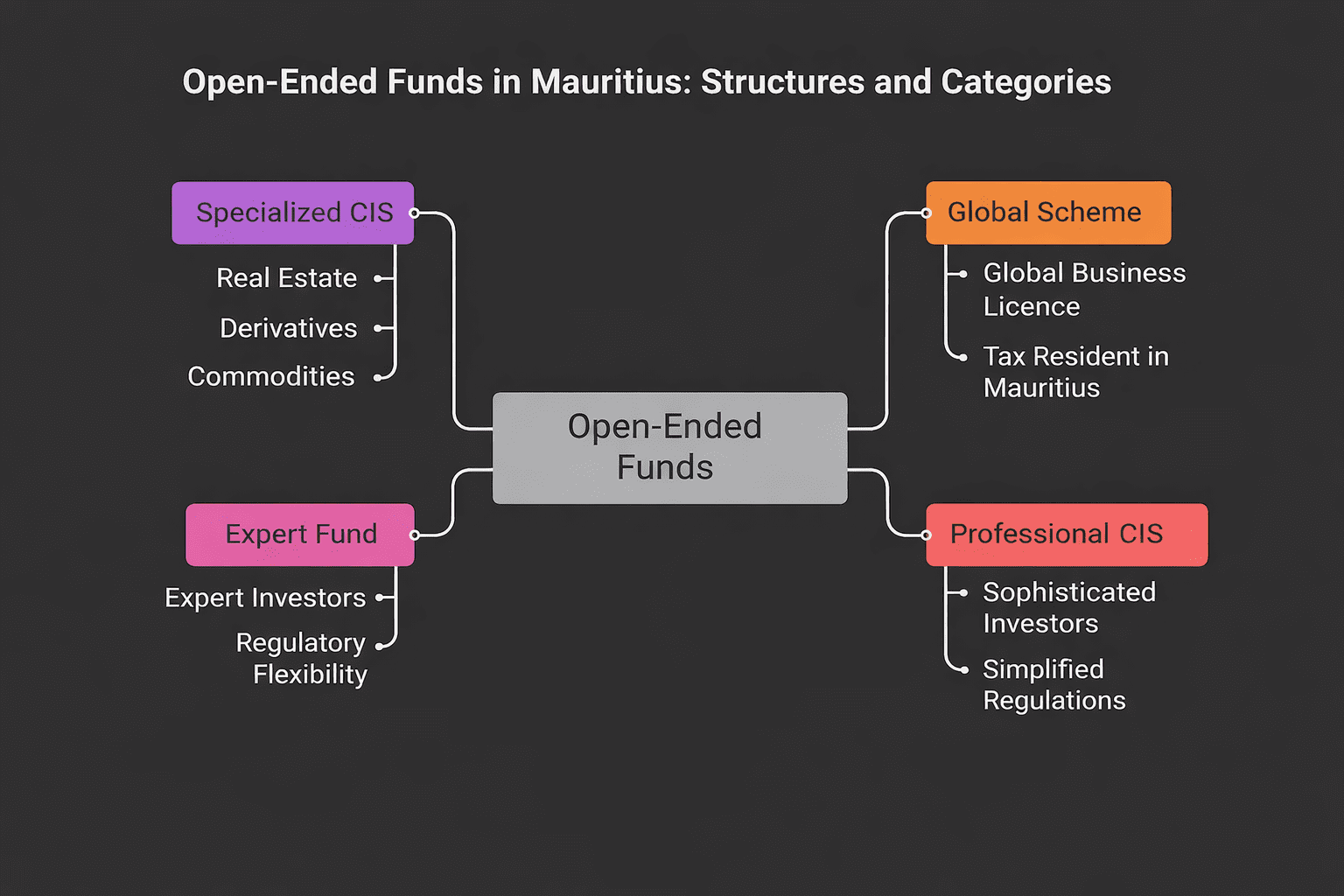
A. Open-Ended Funds: Collective Investment Schemes (CIS)
Open-ended funds allow investors to subscribe and redeem units on an ongoing basis at Net Asset Value (NAV). Notably, this structure offers high liquidity and operational flexibility for institutional investors.
Global Scheme: The Institutional Gold Standard
A Mauritius-incorporated fund holding a Global Business Licence (GBL), the Global Scheme operates under the Securities Act, 2005 and CIS Regulations, 2008. Significantly, it can raise capital from both retail and institutional investors while qualifying as a Mauritius tax resident with full DTAA access.
Best suited for: International fund managers seeking maximum regulatory credibility, broad investor reach, and efficient treaty optimization.
Professional Collective Investment Scheme
This lightly regulated structure restricts participation to sophisticated or private placement investors. Consequently, it benefits from regulatory exemptions and simplified documentation requirements, provided there is no public offering.
Best suited for: Closed, selectively distributed investment vehicles targeting high-net-worth individuals and institutional investors.
Expert Fund Structure
Limited to expert or high-net-worth investors with minimum USD 100,000 investments, the Expert Fund offers greater operational and regulatory flexibility. Furthermore, reduced compliance obligations make it suitable for complex or niche investment strategies.
Specialized CIS for Alternative Assets
Tailored for alternative asset classes such as real estate, commodities, or derivatives, the Specialized CIS operates under asset-specific regulations. Notably, this structure supports advanced and non-traditional strategies for specialized fund managers.
B. Closed-End Funds: Private Equity and Venture Capital
Closed-end funds maintain a fixed capital base raised at inception, with investors remaining locked in until exit or fund termination. Therefore, this structure aligns perfectly with private equity and venture capital strategies.
Standard Closed-End Fund
This flexible private fund structure accommodates PE/VC strategies through multiple legal forms including Company, Limited Partnership, Trust, Protected Cell Company, or Foundation. Additionally, distribution occurs via private placement to institutional and sophisticated investors, typically with 7-10 year lock-ups.
Tax treatment depends on form—transparent for Limited Partnerships, opaque for corporate/GBL structures. Accordingly, managers can optimize based on investor tax profiles through strategic transfer pricing arrangements.
The VCC Advantage: Modern Multi-Strategy Solutions
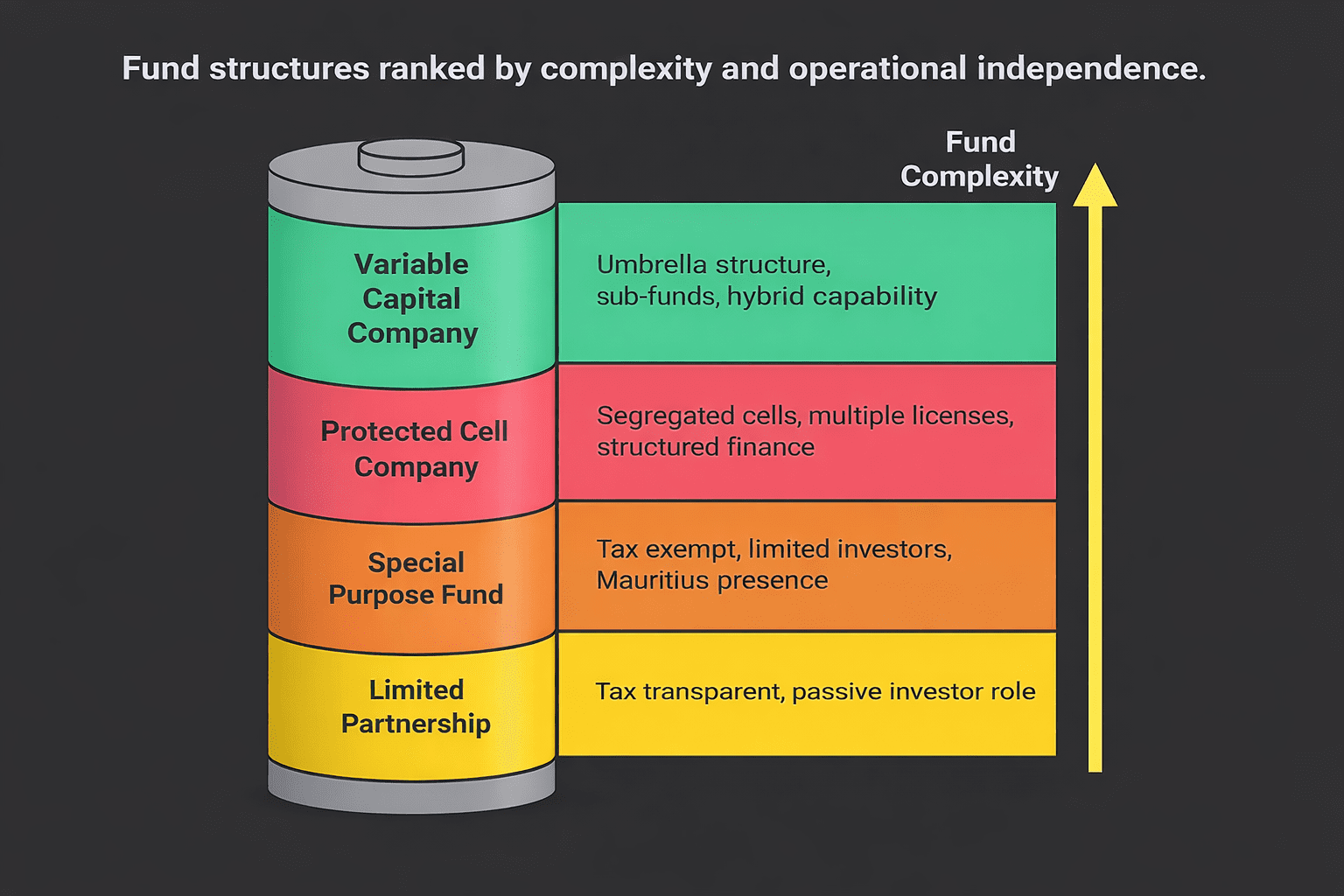
Introduced in 2022 and rapidly gaining adoption in 2026, the Variable Capital Company (VCC) represents the most sophisticated fund structure available in Mauritius. Specifically, this modern umbrella fund structure allows multiple segregated sub-funds under a single entity and license.
Key VCC Benefits
- Statutory Asset Ring-Fencing: Each sub-fund maintains legally protected segregation of assets and liabilities
- Cost Efficiencies: Single Global Business Licence covers all sub-funds, reducing per-fund licensing costs significantly
- Operational Flexibility: Supports both open-ended and closed-ended strategies within the same umbrella
- Simplified Administration: Consolidated reporting and governance requirements across sub-funds
- Scalability: Add new sub-funds without separate incorporation or licensing processes
Protected Cell Company (PCC) Alternative
While similar to VCC, the PCC offers segregated cells without separate legal personality for each cell. Although more economical for structured finance and insurance-linked vehicles, it provides less flexibility than the VCC structure for active fund management.
Regulatory Framework and FSC Requirements
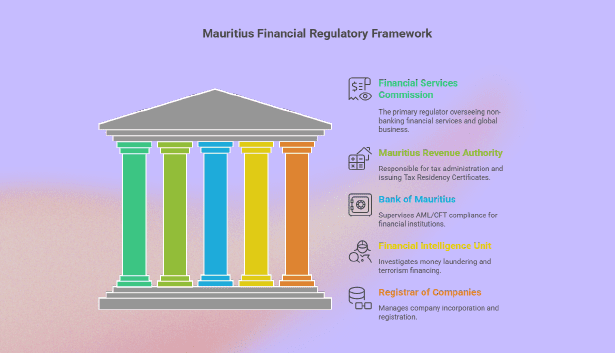
The Financial Services Commission (FSC) operates as Mauritius’ principal regulator for non-banking financial services and global business sectors. Established in 2001, the FSC derives authority from key financial statutes. Moreover, it maintains responsibility for licensing, regulating, and supervising funds and fund managers.
Primary Regulatory Bodies
1. Financial Services Commission (FSC)
The FSC’s mandate spans fund authorization for both CIS and CEF structures, ongoing compliance oversight, enforcement actions, AML/CFT supervision, and investor protection. Importantly, the FSC One Platform serves as a centralized digital interface for licensing, approvals, and compliance monitoring—significantly streamlining the application process.
2. Mauritius Revenue Authority (MRA)
The MRA administers taxation and issues Tax Residency Certificates (TRCs), which are essential for accessing Mauritius’ extensive DTAA network. Moreover, obtaining TRC status requires demonstrating genuine economic substance through local directors, banking relationships, and operational presence.
3. Bank of Mauritius (BOM)
As the central bank, BOM maintains AML/CFT supervisory responsibilities for designated financial institutions. Furthermore, it issues guidelines promoting a risk-based compliance framework aligned with international standards.
4. Financial Intelligence Unit (FIU)
The FIU serves as the national authority for receiving and analyzing Suspicious Transaction Reports (STRs). Additionally, it coordinates anti-money laundering and counter-terrorist financing efforts across the financial sector.
5. Registrar of Companies (CBRD)
The Business Registration Department handles incorporation, registration, and maintenance of official records for companies and legal entities. Consequently, all funds must complete corporate registration before FSC licensing approval.
The 16-Week Formation Roadmap
Successful Mauritius fund formation depends on executing a rigid sequence of interdependent activities. Furthermore, incomplete documentation or inadequate substance preparation typically triggers 2-4 week delays in FSC approval timelines.
Phase 1: Pre-Application (Weeks 1-4)
This critical planning phase establishes the foundation for successful formation. Specifically, managers must complete several key activities:
- Structure Selection: Determine optimal fund structure based on investor profile, asset class, and operational requirements
- Documentation Drafting: Prepare fund constitution, offering memorandum, investment management agreement, and all ancillary documentation
- Due Diligence: Complete comprehensive due diligence on fund promoters, General Partners, and investment teams
- Business Strategy: Finalize detailed investment strategy, target assets under management (AUM), and return projections
- AML/CFT Framework: Establish preliminary compliance policies and appoint Money Laundering Reporting Officer
- Service Provider Engagement: Secure commitments from fund administrator, auditor, legal counsel, and tax advisors
Phase 2: FSC Application (Weeks 5-12)
The FSC review process typically requires 6-8 weeks but can extend to 12 weeks for complex structures. During this phase, several critical milestones occur:
- Application Submission: Submit complete FSC application through the FSC One Platform with all supporting documentation
- Initial FSC Review: Regulators conduct preliminary assessment and identify any deficiencies (typically 2-3 weeks)
- Response to Queries: Address FSC questions within the mandatory 10-day response window to avoid reset of review timeline
- Final Review: FSC conducts comprehensive assessment and issues authorization decision
Phase 3: Post-Approval Operationalization (Weeks 13-16)
Following FSC authorization, several critical activities enable fund operations:
- License Issuance: Obtain final FSC license and Global Business Licence certificates
- Banking Activation: Complete bank account opening with supporting KYC documentation
- Tax Registration: Apply for Tax Residency Certificate from Mauritius Revenue Authority
- Share Issuance: Issue initial shares and register in statutory registers
- Board Meeting: Conduct first board meeting to approve operational policies
- Investor Systems: Activate investor reporting and subscription/redemption processing systems
- Marketing Commencement: Begin formal investor outreach and capital raising activities
Complete Cost Analysis and Economics
For institutional fund managers, understanding the complete cost structure—both initial setup and ongoing operational expenses—proves essential for accurate business planning and LP communications.
Initial Setup Costs (One-Time)
| Category | Standard CIS | Complex VCC |
|---|---|---|
| FSC Application & Processing | $350 – $2,000 | $500 – $2,000 |
| Government Incorporation Fees | $500 – $1,950 | $750 – $1,950 |
| Legal Documentation | $4,000 – $8,000 | $8,000 – $15,000 |
| Fund Administrator Setup | $2,000 – $5,000 | $3,000 – $8,000 |
| AML/CFT Framework | $1,000 – $3,000 | $2,000 – $5,000 |
| Offering Document/PPM | $3,000 – $8,000 | $5,000 – $12,000 |
| TOTAL SETUP COST | $20,000 – $40,000 | $35,000 – $60,000 |
Annual Operating Costs (Recurring)
| Category | Annual Cost Range |
|---|---|
| FSC License Fees (CIS/CEF) | $1,300 – $3,500 |
| Global Business License | $2,000 – $3,000 |
| Fund Administration (Monthly) | $18,000 – $42,000 |
| External Audit (Annual) | $3,000 – $8,000 |
| AML/CFT Compliance Review | $2,000 – $4,000 |
| Company Secretarial Services | $1,500 – $3,000 |
| TOTAL ANNUAL OPERATING COST | $32,000 – $60,000+ |
Tax Optimization and DTAA Network
Mauritius offers a highly competitive and predictable tax framework specifically designed for investment funds. Moreover, the jurisdiction’s extensive DTAA network provides strategic advantages for cross-border investment flows.
Core Tax Benefits
- Zero Capital Gains Tax: No taxation on capital gains realized by funds
- No Withholding Tax: Zero withholding tax on outbound dividend, interest, or royalty payments to non-residents
- Foreign Tax Credits: GBL funds receive credit for foreign taxes paid, significantly reducing effective tax rates
- CIS Tax Exemptions: Collective Investment Schemes enjoy exemptions on interest income
- LP Tax Transparency: Limited Partnerships remain tax transparent unless opting for corporate treatment
DTAA Network Access
Mauritius maintains Double Taxation Avoidance Agreements with 45+ jurisdictions, including major economies such as India, China, South Africa, and most European nations. Consequently, funds structured through Mauritius can achieve significant withholding tax reductions on portfolio income through professional bespoke tax strategy development.
Substance Requirements for Treaty Access
To qualify for DTAA benefits, funds must demonstrate genuine economic substance in Mauritius. Essential requirements include:
- Tax Residency Certificate (TRC) from Mauritius Revenue Authority
- Mauritius-resident directors conducting board meetings locally
- Physical presence and adequate staffing relative to operations
- Strategic decision-making occurring in Mauritius
- Mauritius bank accounts and fund administration
Ongoing Compliance and Reporting
Authorized funds remain subject to continuous regulatory oversight designed to maintain investor protection and market integrity. Therefore, managers must establish robust compliance frameworks from day one.
Mandatory Reporting Requirements
- Annual Financial Statements: Audited IFRS-compliant financial statements filed within 6 months of year-end
- NAV Calculations: Regular Net Asset Value determinations according to fund terms (daily, weekly, monthly, or quarterly)
- Investor Reporting: Periodic statements detailing portfolio holdings, performance, and fee calculations
- FSC Returns: Quarterly and annual regulatory filings through FSC One Platform
- AML/CFT Audits: Independent annual reviews of anti-money laundering compliance programs
- Transaction Monitoring: Ongoing due diligence and suspicious transaction reporting
ESG and Sustainability Reporting
Increasingly, ESG-labelled funds must meet enhanced sustainability reporting standards. Specifically, managers should prepare for these requirements:
- Climate risk disclosures aligned with TCFD recommendations
- Diversity, equity, and inclusion metrics for portfolio companies
- Environmental impact assessments and carbon footprint tracking
- Social responsibility and governance factor integration documentation
Investor Qualification Criteria
Mauritius fund regulations establish clear investor classification criteria determining fund structure suitability and marketing restrictions.
Retail Investors
Retail investors may invest only in public Collective Investment Schemes (CIS) with full regulatory protections. Consequently, these funds face stricter oversight, enhanced disclosure requirements, and investment restrictions designed to protect less sophisticated investors.
Sophisticated (Professional) Investors
Sophisticated investors qualify based on professional expertise, financial capacity, or FSC recognition. Specifically, eligibility criteria include these factors:
- Employment in regulated financial institutions
- Recent professional experience in private equity or SME financing
- Senior corporate management roles
- Meeting defined income, portfolio value, or assets-under-management thresholds
Expert Investors
Expert investors represent a subset of sophisticated investors making minimum initial investments of USD 100,000. Furthermore, they may access Expert Funds operating under simplified regulatory requirements with eligibility typically confirmed through self-certification.
Best Practices for Fund Managers
Drawing from extensive experience across 62+ fund formations, several critical success factors consistently emerge for managers establishing Mauritius funds.
1. Engage Experienced Local Partners Early
The FSC applies rigorous standards on governance, substance, and ongoing oversight. Therefore, working with experienced Mauritius-based legal counsel, administrators, and tax advisors from day one significantly reduces approval timeline risk and ensures regulatory compliance.
2. Develop Investor Relationships Before Launch
Pre-launch investor commitments dramatically influence fundraising success and timeline. Consequently, managers should secure anchor investors or cornerstone commitments before incurring substantial formation costs.
3. Select Reputable, Well-Audited Administrators
Fund administrators with ISAE 3402 certification and strong regulatory track records enhance institutional investor confidence. Moreover, administrators with robust technology platforms streamline reporting and compliance obligations.
4. Consider Scalable Structures for Multi-Strategy Managers
Managers planning multiple strategies or future fund launches should evaluate the VCC structure’s economies of scale. Specifically, the single-license, umbrella structure significantly reduces per-fund costs as the platform scales.
5. Maintain Strong Governance Discipline
Board composition, decision-making documentation, and meeting frequency receive close FSC scrutiny. Therefore, establishing robust governance protocols from inception prevents compliance issues and demonstrates substance for treaty qualification.
Ready to Establish Your Mauritius Fund?
Strategix International provides end-to-end advisory for Mauritius fund formation, from structure selection through FSC licensing and ongoing compliance. Our team has successfully guided 60+ fund formations across CIS, VCC, and PE structures.
Schedule Your Confidential ConsultationRelated Resources
For fund managers evaluating international domicile options:
- Offshore Fund Structuring & Licensing Advisory
- Cross-Border Tax Optimization for Investment Funds
- Multi-Jurisdictional Tax Planning Services
- Transfer Pricing for Fund Management Structures
- Cryptocurrency & Digital Asset Fund Taxation
- Bespoke Tax Strategy & C-Suite Advisory
- AML/CFT Compliance Framework Development
Authoritative External Resources
For comprehensive regulatory and treaty information:
- Financial Services Commission Mauritius – Official regulator website
- OECD Tax Treaties – Model Tax Convention and international standards
- Financial Action Task Force (FATF) – AML/CFT global standards
- OECD BEPS Action 6 – Preventing tax treaty abuse guidance